 |
|
Dear friends and colleagues,
Last week I was thinking about a conversation I had with a district leader who said, "We know what we want to do with competency-based learning. We just don't know how to make it happen." This is the tension that so many thoughtful leaders live with as they launch CBE initiatives. We've moved past the question of whether future-ready competencies matter: the research is clear that the current model isn’t working, the rapid arrival of AI creates an urgent need, and most educators I meet understand both. What's less clear is how to navigate the messy reality of the change itself: who starts, at what pace, with what supports, and under what conditions.
The most successful initiatives I've seen blend insights from different traditions. Some draw on Everett Rogers' early adopter work, starting with the “coalition of the willing,” and slowly expanding the work in ever widening circles, to eventually include even the skeptics (Rogers, 2003). Others embrace collective leadership approaches, building teams that distribute ownership and decision-making so changes related to CBE don’t live or die with one leader (West, et al, 2014). Still others take a developmental stance, treating implementation as an evolving experiment where you learn and adapt as conditions shift (Smith & Spooner, 2021).
An example of a hybrid approach: South Carolina's PCBE journey started with willing districts, built collective structures for shared learning, and continuously adapted as political leadership changed and educator capacity grew. By the end of 5 years, over 80% of districts had engaged in some level of activity, and several had begun deep shifts in practice and structures.
The point isn't picking the "right" model. It's reading your context honestly, understanding your leadership “leanings,” naming the tradeoffs each approach requires, and building a rollout your community can actually sustain. This issue of the CBE Catalyst Newsletter offers tools to help you along the way.
Warmly,
Antonia
|
|
|
|
IN THIS EMAIL
→ Focus your CBE initiative with the 5-dimension Change Leadership Framework.
→ Decide which change model best fits your context with our AI-powered selector.
→ Design professional learning that mirrors the classrooms you want to create.
→ Coming in February: A full CBE Strategy Toolkit to catalyze and support your vision. |
|
|
|
|
|
FOCUS YOUR CBE INITIATIVE |
|
Five Dimensions That Determine Whether Your CBE Initiative will stick |
 |
|
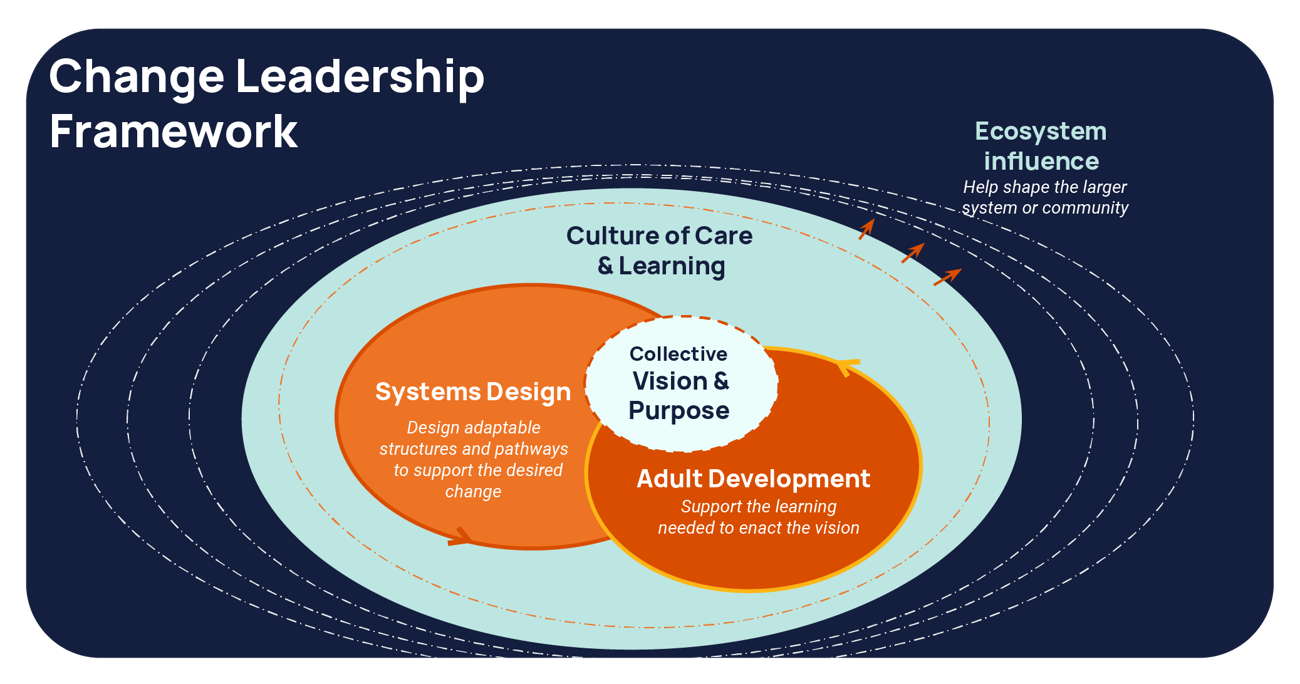
When launching CBE initiatives it’s tempting to jump straight to "systems design"—competency frameworks, grading policies, crediting decisions—without adequately attending to the other critical conditions that make systems changes viable. A new bell schedule means nothing if adults haven't developed the capacities they need to use that time to nurture students in developing future-ready competencies, or if the culture doesn't support the risk-taking required for new CBE practices.
reDesign’s Change Leadership Framework hones in on five interconnected dimensions (Collective Vision, Culture of Care, Adult Development, Systems Design, and Ecosystem Influence) that consistently show up in successful CBE initiatives. The framework isn't linear—you don't complete one dimension before moving to the next. Instead, it’s iterative, offering reflection questions to help you diagnose where your current initiative is strong, and where it might need additional bolstering.
|
| EXPLORE THE FRAMEWORK |
|
Once you understand which dimensions need your attention, the next question is: Which change approach matches your conditions?
|
|
|
 |
|
NEW AI TOOL |
|
Determine Your Model for Change
One of the most consequential decisions in CBE work is rarely discussed: not just what you're changing, but who starts, at what pace, and under what conditions. Well-designed initiatives can stall because leaders lack support in navigating the tradeoffs between different rollout strategies.
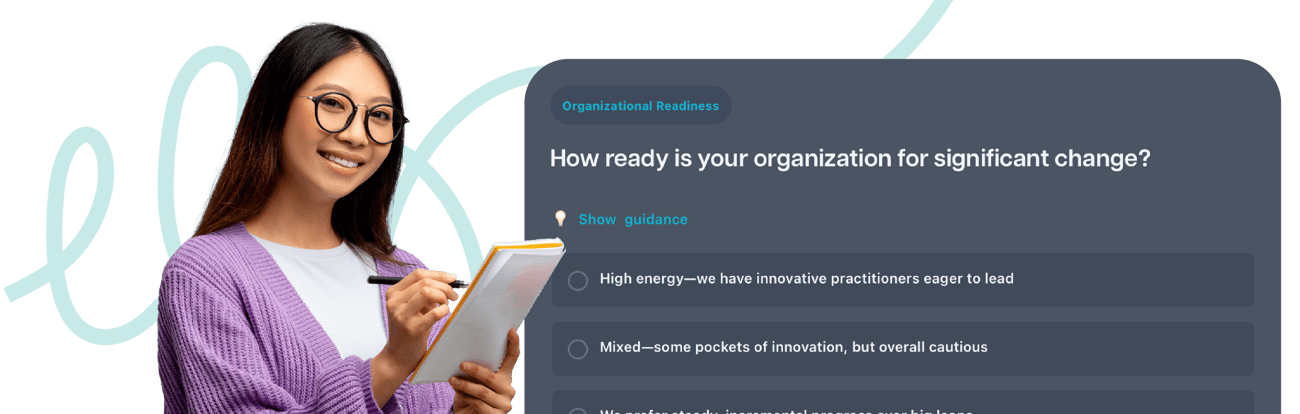
The AI-powered Change Model Selector asks diagnostic questions about your stakeholder readiness, resource constraints, and change history, then maps these factors to three research-based approaches: Early Adopter, Collective Leadership, and Developmental models. It won't tell you what's "right"—there isn't a universal answer. What it will do is name the risks, conditions for success, and honest tradeoffs that come with each choice. The goal is to build a rollout your community can sustain, not a perfect plan that looks good on paper. |
| TRY THE TOOL |
|
AND, choosing a change model is only the first step. Sustainable transformation requires adults to experience the competency-based learning we want to provide young people. |
|
|
 |
|
DESIGNING PROFESSIONAL LEARNING |
|
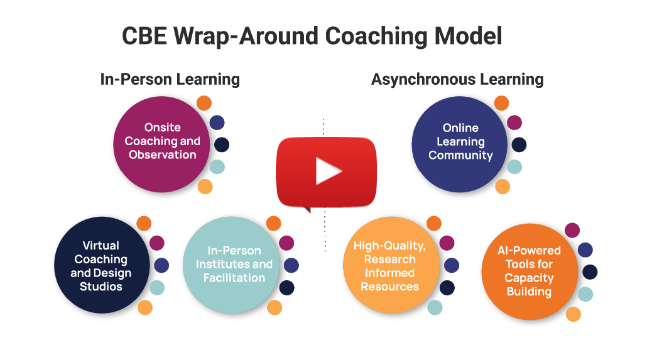
CBE Wrap-Around Coaching Model
Schools and districts that succeed with CBE transformation don't just train teachers on new practices—they structure professional learning the same way they want classrooms to function. Tracy Bauer, one of our Catalyst coaches, explains reDesign's wraparound model in this short video: blending in-person design work, virtual coaching, asynchronous resources, and teacher-led community. The flexibility matters because every context brings different starting points, available time, and budget realities.
What makes this work isn't the specific blend of supports. It's the principle underneath: adults need to experience competency-based learning themselves before they can create it for students. When teachers practice setting learning goals, getting targeted feedback, iterating on their designs, and reflecting on their process, they internalize what this feels like from a learner's perspective. That embodied understanding changes everything.
Curious how to create an approach for your context? |
|
|
|